Maruti Suzuki is gearing up for one of its most anticipated launches ever, and the excitement in the Indian automotive market is already building. The fully electric Maruti Suzuki e-Vitara, tailored specifically for India, is set to go on sale in early 2026, marking a major milestone for the country’s largest carmaker as it moves deeper into the EV space. With growing competition, rising demand for clean mobility, and expanding charging infrastructure, the e-Vitara is arriving at the perfect time.
A Landmark EV for Maruti Suzuki
While several rivals have already entered the electric SUV segment, Maruti Suzuki has been preparing its EV strategy carefully. The India-spec e-Vitara is expected to be the brand’s first mass-market electric SUV, designed to offer a balance of affordability, practicality, and modern tech — the very formula that made Maruti a household name.
Built on Suzuki’s upcoming electric platform and developed with Toyota’s global EV expertise, the e-Vitara promises to be a strong competitor in India’s fast-growing electric SUV market.
Maruti Suzuki e-Vitara Fresh Design With a Modern EV Identity
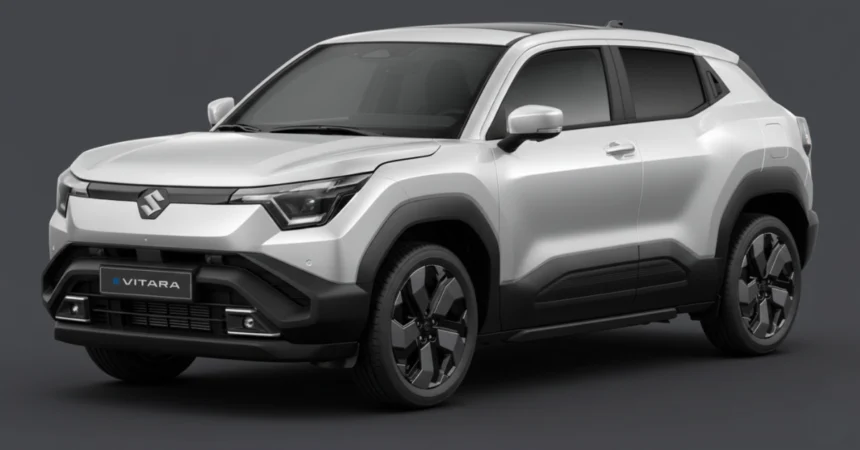
The e-Vitara is expected to carry a bold new look compared to its ICE sibling. While Maruti is keeping final design details under wraps, early teasers point to a more aerodynamic shape, a closed-off EV-style grille, sharp LED lighting, and a futuristic front fascia. Distinctive alloy wheels, a high stance, and a clean-surface design philosophy will give the SUV a premium, tech-forward visual appeal.
Inside, the cabin is likely to feature:
- A large touchscreen infotainment system with connected tech
- Digital instrument cluster
- Soft-touch dashboard materials
- Ventilated seats (expected in top variants)
- Panoramic sunroof (a key feature Indian buyers love)
Maruti is clearly preparing the e-Vitara to compete not only on price but also on overall experience.
Competitive Range and Performance Expected
Though official specifications are not yet confirmed, industry reports suggest the India-spec e-Vitara may be equipped with a 60 kWh battery pack, offering an estimated range of 450–500 km on a single charge. Fast-charging capabilities are expected to be part of the package, allowing the EV to recharge from 20% to 80% in less than an hour with compatible DC chargers.
Performance is likely to be tuned for city-friendly acceleration and comfortable highway cruising. Expect strong low-end torque — one of the natural strengths of electric motors — making the e-Vitara ideal for urban traffic and weekend getaways.
Safety and Technology Upgrades
As India’s safety expectations rise, the e-Vitara is expected to include modern driver-assistance features such as:
- 360-degree camera
- Adaptive cruise control
- Lane-keeping assist
- Blind-spot monitoring
- Autonomous emergency braking
These features, paired with a strong battery safety architecture, will position the SUV as one of the more advanced EVs in its segment.
Launching at the Right Time
With EV adoption accelerating and state-level incentives improving affordability, early 2026 is a strategic launch window for Maruti Suzuki. The brand’s wide dealer network will also give the e-Vitara a major advantage, bringing EV accessibility to smaller towns and rural regions — areas where competing EV makers are still building their presence.
Expected Price and Competitors
Maruti Suzuki is likely to price the e-Vitara competitively, aiming for a starting price between ₹15–20 lakh, depending on variant and battery size. This will place it directly against rivals like the Tata Curvv EV, Mahindra BE.05, MG ZS EV, Hyundai Creta EV, and upcoming budget-friendly EVs from Toyota and Kia.
Final Thoughts: A Potential Game-Changer
The India-spec Maruti Suzuki e-Vitara represents a major shift in Maruti’s EV strategy and could play a key role in accelerating India’s transition to electric mobility. With competitive pricing, long range, smart design, and a trusted brand name behind it, the e-Vitara is shaping up to be one of the most impactful EV launches of 2026.
If Maruti delivers on its promises, the e-Vitara could set new benchmarks for mass-market electric SUVs in India — and once again redefine what Indian customers expect from an affordable electric vehicle.