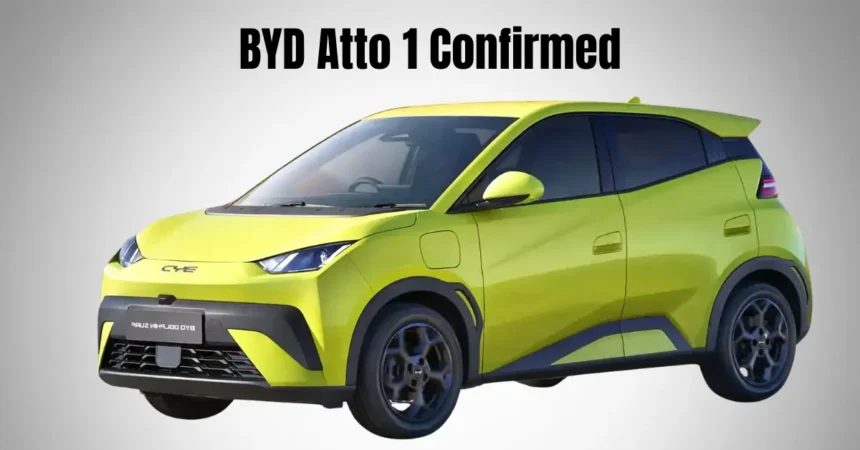
Australia’s EV landscape is about to get more competitive. BYD has confirmed that its compact hatchback, the Atto 1 (also known overseas as the BYD Seagull), will arrive locally later this year — and by pricing it below its existing line-up, BYD promises it will become the cheapest electric car in Australia by a significant margin.
Set for a November launch, the Atto 1 is part of BYD’s push to dominate volume EV sales in the Australian market. The company says it wants to make electric mobility accessible without major compromises on safety, features or range. Let’s break down what we know so far — and what questions remain.
According to Australian EV analysts, BYD’s strategy mirrors Tesla’s early expansion phase — lowering costs while maintaining cutting-edge technology. With strong after-sales support through EVDirect and partnerships with Evnex and Chargefox, BYD’s infrastructure footprint is growing fast.
The Atto 1’s success will depend on local tuning, crash ratings, and supply consistency. Still, with BYD’s growing global credibility and manufacturing scale, it’s likely to become a game-changer for budget EV buyers.
Engine Options & Performance
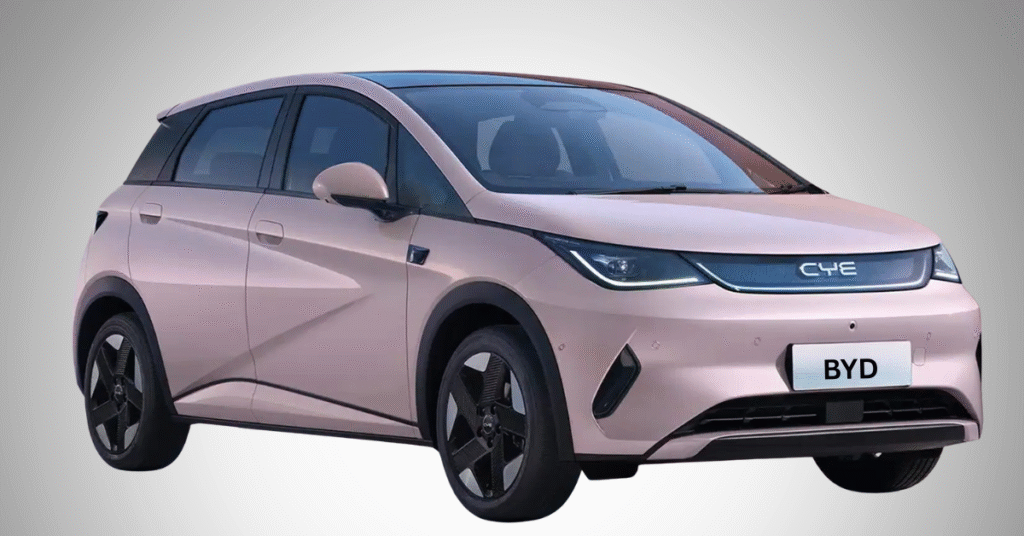
- The Atto 1 is a battery-electric vehicle (BEV) — there is no internal combustion engine variant.
- In its overseas (China / other markets) incarnation, it uses a single front-mounted electric motor (FWD).
- Power and torque figures in some markets: about 55 kW (≈ 75 PS) and 135 Nm.
- Top speed is limited (often ~130 km/h), reflecting its city/urban focus.
- Acceleration is modest — it’s built more for efficiency and daily driving than performance.
Because the Australian specification is yet to be formally published, these figures remain indicative. What’s clear, though, is that BYD is positioning Atto 1 as a practical and affordable city commuter EV rather than a performance machine.
Safety & Driver Assistance
- Atto 1 is expected to come with a full suite of ADAS features, including autonomous emergency braking, lane keeping assist, traffic sign recognition, and more.
- The global brochure mentions features like blind-spot monitoring, rear cross-traffic alert, and 360° camera in higher trims.
- While specific crash test ratings in Australia or ANCAP haven’t been confirmed yet, BYD will need to meet Australian safety and regulatory standards before sale.
- Because Atto 1 is derived from the BYD Seagull/“ocean series” small EVs, it carries many of the safety architectures common in BYD’s ladder of models, including a strong battery safety design (using LFP “Blade” battery technology) to reduce fire risk.
We will watch closely for confirmed ANCAP (or equivalent) ratings once independent testing begins locally.
EV Range & Charging
- Official published range overseas: 305 km (base versions) and up to 405 km in longer-range editions under local testing cycles (e.g. CLTC / Chinese standard).
- Real-world range will almost certainly be less; differences due to temperature, load, driving style and speed must be expected.
- Battery capacity: about 30.08 kWh (for base versions) in some market specs.
- Charging: fast (DC) charging from ~30 % to 80 % is expected in ~30 minutes in some versions.
- The car’s consumption in published specs is around 0.10-0.11 kWh/km (10–11 kWh/100 km) in ideal conditions.
Again, Australian WLTP/ADR ratings may differ, so expect a drop from publish claims under local conditions.
Comparison Table with Competitors
Below is a rough comparison between the Atto 1 (projected spec) and a few existing affordable EVs in or entering Australia:
| Model | Approx Range | Power / Torque | Key Strengths | Weaknesses / Risks |
|---|---|---|---|---|
| BYD Atto 1 | 305–405 km (nominal) | ~55 kW / 135 Nm | Very low entry price, BYD’s battery safety tech, full ADAS set | Modest power, pending safety ratings, real-world range may shrink |
| MG ZS EV (base) | ~320 km WLTP | ~105 kW / 210 Nm | Proven in market, dealer support, established safety credentials | Higher price, less premium interior in base trims |
| GWM Ora (if enters) | ~400 km+ | ~125 kW+ | Bold styling, competitive range | Brand recognition, infrastructure support |
| BYD Atto 2 (compact SUV) | ~420–450 km (expected) | ~150 kW+ | Higher flexibility, more power, SUV appeal | Likely higher cost, may cannibalize Atto 1 |
These comparisons are speculative in some parts — but they help frame where Atto 1 might sit in the competitive landscape: toward the ultra-value, city EV niche.
What This Offer Means for Buyers & the Market
- BYD’s strategy is aggressive: introduce an EV with minimal margin or tight pricing to broaden volume adoption.
- For first-time EV buyers or those on a tighter budget, the Atto 1 could lower the barrier to entry in Australia’s electrification push.
- The company will need to ensure that after-sales, servicing, and parts support are in place for confidence.
- If BYD delivers decent real-world range, safety, and reliability at a lower cost, it could force rivals to drop prices or boost incentives.
- Expect scrutiny by press and early adopters: how closely the published specs match daily use will be a key test.