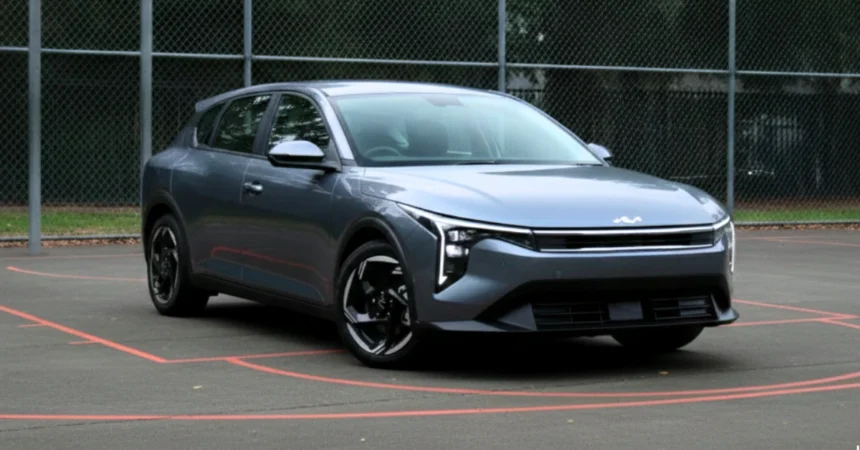
The 2026 Kia K4 hatchback steps in as a modern replacement for the outgoing Cerato hatch, set to hit Australian roads in early 2025. This model joins the K4 sedan lineup, aiming to spark renewed enthusiasm in the shrinking small car category, where sales have plummeted—think Toyota Corolla numbers tumbling from over 40,000 annually a decade ago to around 24,000 today, overshadowed by SUVs and pickups. Embracing Kia’s bold “Opposites United” styling, the K4 hatch sports a sleeker, more adventurous look with rugged plastic cladding around the wheels for a crossover vibe and a compact tail that nods to wagons. It’s noticeably shorter than its sedan sibling by about 270mm but keeps the same extended wheelbase for better interior room. Starting at roughly $32,090 before on-road fees, it offers solid bang for the buck in a segment packed with options like the Corolla and Mazda3, though it’s pricier than the old Cerato. Look for a hybrid variant arriving in 2026, probably borrowing a 104kW 1.6L setup from Hyundai’s i30.
Advantages
- Exceptional ride quality tuned for local conditions.
- Roomy and functional cabin with top-tier cargo space.
- Modern tech and strong value across trims.
Drawbacks
- Hybrid option not available at launch.
- Some features absent compared to international versions.
- Base engine could use more polish at high speeds.
General Evaluation
The K4 hatchback emerges as a compelling choice in the fading small car arena, delivering a fun drive, ample space, and contemporary appeal that makes it a smarter pick over many entry-level SUVs.
Market Standing
In the compact hatchback space, the K4 competes head-on with models like the Toyota Corolla (starting around $30,000), Mazda3 ($32,000+), and even crossovers like Kia’s own Stonic. It’s bigger than most rivals, with superior boot volume, and targets buyers eyeing efficient, practical daily drivers rather than trendier SUVs.
Notable Changes for 2026
This redesign brings a fresh aesthetic, upgraded materials, and enhanced efficiency. The base 2.0L engine now uses an Atkinson cycle for better fuel sipping, while the turbo 1.6L tops the range for spirited performance. Australian-specific suspension tuning ensures it handles local roads with poise, and the interior tech gets a major refresh with over-the-air updates.
Pricing Guide and Suggestions
Expected starting figures (plus on-roads):
- S: $32,090
- Sport: $36,690
- Sport+: $39,090
- GT-Line: $43,790
The Sport trim offers a sweet spot with added comforts like enhanced safety aids. For performance fans, the GT-Line’s turbo engine and premium touches justify the extra cost. Opt for the Safety Pack on base models to bump up the ANCAP rating to five stars.
Engines, Transmission, and Handling
Power comes from two petrol options: a 110kW/180Nm 2.0L naturally aspirated four-cylinder in lower trims, or a punchier 142kW/265Nm 1.6L turbo in the GT-Line. The former mates to a refined CVT, while the latter uses an eight-speed auto—all front-wheel drive. Acceleration estimates put the 2.0L at about 9.5 seconds to 100km/h, with the turbo shaving that to 7.5 seconds. On the road, the K4 impresses with balanced dynamics; the GT-Line’s multi-link rear setup provides a compliant yet engaging ride, outshining the firmer old Cerato GT. The base motor handles city and highway duties fine but gets noisy when pushed, though the CVT mimics gears smoothly for a natural feel.
Fuel Use and Range
Manufacturer claims suggest 6.1-7.4L/100km combined, with CO2 at 143-169g/km depending on the variant. Real-world highway cruising can dip below 5L/100km for the 2.0L. The 47L tank supports decent range, and both engines run on regular 91-octane fuel.
Cabin Layout, Comfort, and Capacity
Inside, the K4 feels upscale and airy compared to the cramped Corolla, though it doesn’t quite match the Mazda3’s luxury. A 12.3-inch infotainment screen runs crisp, user-friendly software with wireless updates. Storage is plentiful, with deep bins and cupholders. Rear passengers enjoy generous leg and head space thanks to the stretched wheelbase and low seats. Cargo holds 438L with seats in place—leading the class, beating the Corolla’s 217L—and expands to 1,217L folded. Every model includes a space-saver spare, and higher trims add mood lighting.
Connectivity and Multimedia
Standard kit features a sharp touchscreen with seamless wireless Apple CarPlay and Android Auto integration. Top models upgrade to a full digital cluster and advanced navigation. Audio starts basic but scales up in pricier versions.
Security and Driver Aids
All trims pack essentials like seven airbags, forward collision avoidance with pedestrian/cyclist detection, adaptive cruise, lane centering, blind-spot intervention, rear cross-traffic braking, and driver drowsiness alerts. Base S without the optional pack earns four ANCAP stars; adding it unlocks five stars plus extras like junction assist and dual climate. Upper levels include highway driving assist with auto lane changes.
Service and Protection Plans
- Vehicle warranty: 7 years/unlimited km.
- Roadside help: Up to 8 years.
- Maintenance: Every 15,000km/12 months (2.0L) or 10,000km (1.6L); five-year capped pricing around $2,300-$2,500.
Key Specs (2026 Kia K4 GT-Line Example)
- Layout: Front-engine, front-drive, 5 seats, 5 doors.
- Engine: 1.6L turbo inline-four (142kW, 265Nm).
- Gearbox: 8-speed automatic.
- Dimensions: Length 4,440mm; width 1,850mm; height 1,435mm; wheelbase 2,720mm.
- Weight: 1,388-1,453kg.
- Cargo: 438L (seats up)/1,217L (folded).
- Brakes: Vented discs front/rear.
- Tires: Varies by trim, up to performance-oriented on GT-Line.
- Efficiency: 7.4L/100km combined (claimed).
- Emissions: 169g/km CO2.